
Maximum Security
My summer in max, Gen AI is Gen Z’s Vietnam, the -P convention.

Swaine’s World, June 2026
UP FRONT
In praise of appreciation.
WRITING
My Summer in Max: a Memoir
The Call of Water: Three Invitations
ARTIFICIAL INTELLIGENCE
Gen AI Is Gen Z’s Vietnam
COMPUTER HISTORY
In the Pub: PragPub July 2009
Out of the Fire: After Altair
RECOMMENDED READING
The Dusty Shelf: The -P Convention
Books & Blogs
UP FRONT
This month I’m sharing a piece of original writing, a recollection from my college days, titled “My Summer in Max.” It’s an attempt to write creativenonfiction, sometimes described as “true stories, interestingly told.” Documenting what actually happened, but with the elements of creative writing: characters, dialog, scenes, a beginning and an end, and a story arc.
And as usual, this post includes some thoughts about artificial intelligence, an excerpt from Fire in the Valley, some poetry, and my recommendations for books and blogs I think you might appreciate.
In Praise of Appreciation
I open the curtains to a fine bright first Day of June, the sky an auspicious pre-dawn blue, the full moon just beginning to dip below the western hills, and I tell myself, appreciate it.
•
By the old oak at the end of our driveway the grapevines that envelope our neighbor’s fence have pushed ropelike climbers twenty feet up the tree, wrapping branches and spreading throughout the canopy, to dangle slender tendrils nearly to Nancy’s nose.
I have picked tender grape leaves in the spring, blanched them, rolled them around herbed rice and cooked them with olive oil and lemon juice.
Once, decades ago, Nancy and I spent a weekend in Languedoc-Roussillon, deliberating purchasing a vineyard and winery and emigrating to France. The owners introduced us around town and took us through the vineyards and explained each step of the winemaking process. We lunched together, drinking their wine, in their courtyard overlooking the valley and the village. But when the numbers didn’t work out we explored other business opportunities.
That took us to Oregon where Nancy ran a restaurant and organic farm and put together a thoughtful wine list. What I remember most of those entrepreneurial years are the people: the staff, the customers, the Cisco rep, the mushroom forager, the electrician, the musicians, the theater people who put on plays on our lawn, and the winery reps who would sit and sample wine with us.
In these simpler days it’s usually just the two of us dining at home. And when Nancy pours the wine we never fail to clink glasses, make eye contact, and give one another a heart-deep “Cheers.”
Appreciating.
Appreciate may be my favorite word.
Here with a Loaf of Bread beneath the Bough,
A Flask of Wine, a Book of Verse — and Thou
Beside me singing in the Wilderness —
And Wilderness is Paradise enow.
-Omar Khayyam and Edward Fitzgerald
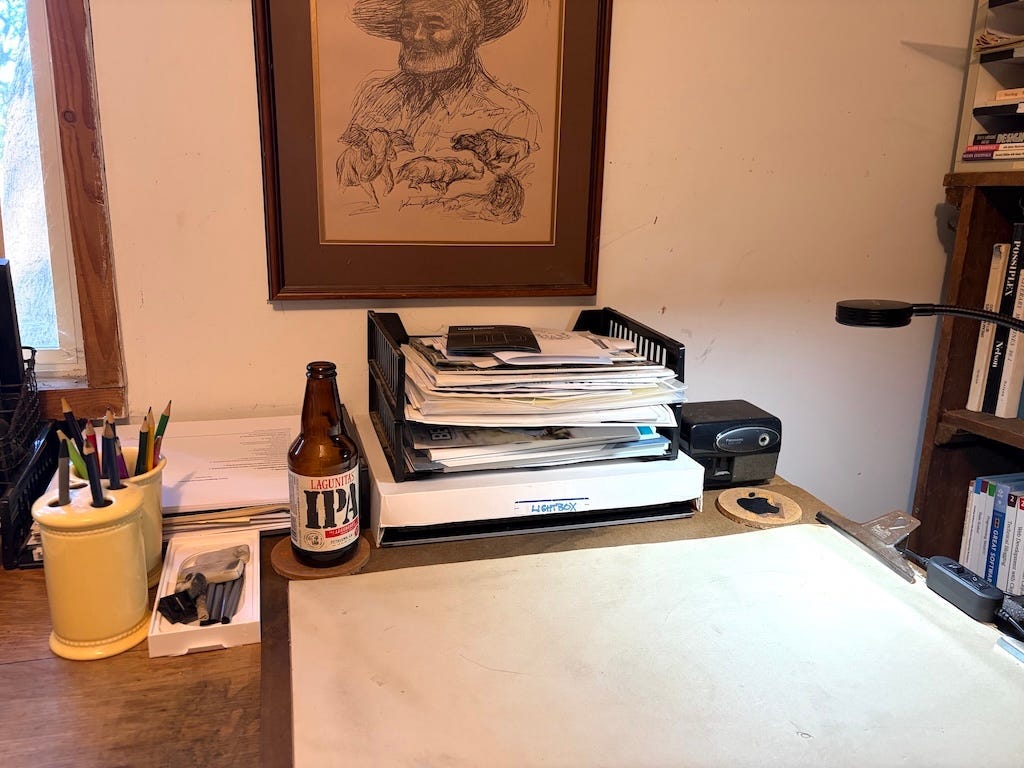
The image: My desk. The picture is less in honor of its subject, Ernest Hemingway, than the artist, Hemingway’s friend and Nancy’s relative, John Groth.
WRITING
My Summer in Max: a Memoir
The summer before my Sophomore year at a small Midwest Mennonite college, I participated in an experimental work-study program in the maximum security ward of a mental hospital.
There were six of us in the program: Tall, thin Janet, a farm girl from Kansas and the first of her family to attend college. Fragile, frightened Sarah, whose voice was a whisper. Grace, the youngest of the Dean’s three daughters, for whom religion was the family business. Plump Caroline, flirty, quick to laugh, the extrovert of the group. Serious, bookish Bret. And me.
I was a fraud. Not only wasn’t I a Mennonite, I wasn’t religious. The Vietnam excursion was in full flower and I had stupidly dropped out of college four years earlier. Now with the draft board breathing down my neck, I regretted losing that student deferment. Goshen College was nearby, it was not expensive: it was convenient.
I never actually had to lie about religion, I just avoided certain topics, smiled my way through ticklish conversations. It could fit in. But I clearly wasn’t like the other students in the program. I was — how to put it? — more worldly. Not to mention four years older.
In fact I was the same age as one of our instructors. James was just out of college himself and full of enthusiasm. It was he who had talked the administration into sending six sophomores off to a mental institution for the summer.
•
The small office was crowded, with the six of us and the ward staff seated on chairs we had brought in from the dayroom. The distinguished-looking older man in the white coat standing by the door was already showing signs of impatience. Anita, the social worker behind the desk, had assembled us, but she immediately deferred to him.
“Doctor Carter, would you like to welcome our guests and explain their duties?”
“Welcome to the madhouse,” he said. “I hope you enjoy your stay.” He shrugged. “I can’t tell you what your duties are because I don’t know. I wasn’t consulted when this program was approved and I have no idea what is expected of you. But — ” he added, smiling, “you should be all right if you just do whatever Anita says. Anita?”
“Thank you, Doctor Carter,” she said. “Doctor Carter is the head of psychiatry for the entire hospital and is a very busy man.”
As she introduced the other staff, I sized her up. Thirtyish, blond hair pulled back into a ponytail, beige pantsuit from Woolworth’s, permanent worry lines between her eyebrows. Other than Doctor Carter none of the staff wore any kind of uniform, I noticed, and they all went by their first names. The ward nurse, Pearl, was about the same age as Anita. She wore her hair in a Motown bouffant and looked skeptical about everything. An orderly named Elijah couldn’t have been more than twenty.
Grace, the dean’s daughter, had a question that had been puzzling all of us. “They say this is maximum security. Why were we assigned to this particular ward?”
“Beats me,” Doctor Carter said.
“Doesn’t it mean the patients are dangerous? Are we safe here?” Sarah wanted to know.
Nurse Pearl answered her. “You don’t need to worry about your safety, darlin’. Most of our patients are on some level of medication to control their behavior. If you ever feel uncomfortable, you come see me.”
Elijah the young orderly nodded. “That’s right. You listen to what Nurse Pearl says. But still and all, don’t forget you’re in Max. So you want to go to the bathroom, you ask me, I’ll unlock the door and let you down the hall. Just buzz when you come back. And don’t never go into the patients’ rooms or down that hall.”
Doctor Carter slipped out while Anita was explaining what was expected of us. It wasn’t complicated. We were to keep a daily log of patient interaction and our impressions. We were to support the staff in patient care in any way directed. And mostly we were to hang out in the dayroom. “We really want you to spend time with the patients. I’ll check in with you at least once a day and I’ll make sure Doctor Carter finds some time for each of you.”
•
Anita’s office opened onto the dayroom, and, per instructions, that’s where we spent most of every day. In a far corner was the nurse’s station, in a near corner the television, high on a shelf, turned on most of the day. At three PM nearly all the patients and all of the orderlies would stop what they were doing and turn where they stood or pull up chairs, because it was time for Dark Shadows. The crashing waves and eerie music that announced this vampire soap opera would usually set off Jeffy, the hebephrenic, sending him into a frenzy of giggling until Elijah told him to shut up so he could hear the TV.
Hearing the Dark Shadows dialog was a challenge even without Jeffy’s giggling, because Jack and Elroy argued throughout the show. Elroy was from somewhere down south and had got it into his head that the show was about zombies and voodoo, and he loudly criticized the writing on what were, given his interpretation, valid technical grounds. Jack understood the show but apparently found it less entertaining than arguing with Elroy, and egged him on. Eventually Elijah would tell them to shut up.
Sometimes Arthur, who had trouble distinguishing between television and reality, joined in, which added a level of surrealism to their critiques. But this particular afternoon Arthur was unusually quiet. I asked Nurse Pearl if there was something wrong with him.
“They was last night,” she said. “He had an episode. I had to medicate him.” Jeffy giggled and started chanting, “Thorazine, thorazine!” until Elijah told him to shut up.
I wondered if it was wise to let mental patients watch a show about vampires, but I told myself these people were professionals and must know what they were doing.
•
At lunchtime we students would get together to compare notes. In one of our first meetings we focused on one of the more colorful patients, a bulky old man with a dragging gait and a sly eye.
“Has anybody else talked to the one who calls himself the Judge?” Grace asked.
“I have,” Caroline nodded. “I had a long conversation with him yesterday. He’s funny.”
Sarah stared at her. “I don’t know how you can call him funny. He scares me.”
Grace ignored her, focused on Caroline. “You mean funny ha-ha or funny weird?”
“Oh, funny ha-ha.” She put her hand to the top of her belly and burped impressively. “Excuse me. Something I ate. No, see I was telling him about our program. ’Cause he asked what we all were doing here and I was commencing to explain. And he called me this racist name which I will not repeat— ”
Grace winced. “Oh gosh. I’m sorry, Caroline.”
“Oh but I didn’t pay it any mind. ’Cause, you know: he’s crazy. So I told him he was a grumpy old fart.”
“How did he take that?”
“He laughed. And then we started making up nasty names for the other patients. I hope nobody heard us.”
Bret cleared his throat. “I tried engaging with him. He said he had an injunction against me and refused to talk.”
“He said that to me, too,” I said. “The injunction thing. Boy, that fierce stare he gives you when he says it is like he’s pronouncing sentence on your life.”
“Well, I talked with him for a while,” Grace said. “We didn’t do any laughing, but he also didn’t say anything about an injunction.”
“Maybe he just doesn’t like men,” Janet, the farm girl, said.
•
“It’s his defense mechanism,” Jack told me, pushing a pawn forward.
We were free to spend our patient time any way we wanted and the first afternoon Jack challenged me to a game of chess. He beat me easily, and I continued playing him every afternoon, hoping to win a game.
“The Judge has got a standing injunction against the whole staff and the administration,” he said. “Sometimes he lets Anita off the hook. He’s had one against me since I got here because I tried to steal his soul, he said. I couldn’t do it, though, because he had a patent on it. So he had me there.”
“I guess he did. You said since you got here. How long have you been in the hospital?”
“Six, no seven months.”
“I’m sorry, but — I mean — you don’t seem like you belong here.”
“I do when it matters,” he said. “If the need arises I can be impressively paranoid.” He studied the board, nodded to himself, and castled kingside. “I made enemies in the State prison,” he said, looking me in the eyes, “and needed to get out of there for the sake of my skin. Got myself committed, transferred here. And here I stay.”
“And the staff don’t think you’re faking?”
“It doesn’t matter what they think. What matters is how I present during evaluations.”
“But don’t they do tests?”
He made what looked to me like a questionable pawn move. “First thing you learn if you want to get along here is how to take tests. You’ve got to put yourself in the right frame of mind. It’s like they say about the polygraph: It’s not a lie if you believe it. I believe what I need to believe.”
I took the unprotected pawn. “So, if I can ask — what were you in prison for?”
He didn’t look up from the board. “Life. I believe you’re in check.”
•
On Monday morning of the final week of the program, one of our group was missing: Caroline didn’t show up and none of us knew why. At nine o’clock Anita called us into her office.
“Is everyone here?” she asked, settling in behind her messy desk.
“Caroline isn’t,” Bret said.
Anita sighed. “Yes, I know.” She sat up straight. “Shortly after you all left Friday night, Doctor Carter delivered Caroline’s baby. She had a little boy. He and Caroline are doing fine; they’re at her mother’s house back in Goshen and I talked to her on the phone this morning. She won’t be continuing with the program. She wanted me to tell you that she’ll miss you all.”
“Did she know she was pregnant?” Bret asked. He blushed. “I mean, I didn’t, I don’t think any of us did, but — ”
“That’s all I have to say right now. If any of you want to talk about this individually, I’ll make time for you.”
•
We finished out the week but the college cancelled the program after that. We didn’t interact with the patients much during the remaining days. Anita and Doctor Carter kept us busy studying psychological tests.
The big assignment was the Minnesota Multiphasic Personality Inventory. We were to read up on its development and the theory behind it and then take the test, interpret our results, and write up what we learned from the experience.
The version of the MMPI we studied consisted of 567 yes-or-no questions about yourself: your feelings, your thoughts. It was designed to detect psychopathology and quirks of personality structure. In theory there was no theory behind it. Its question topics were drawn from attitudes and beliefs frequently expressed by patients already diagnosed with certain specific pathologies.
To score and interpret an MMPI test, a trained professional would sift through the answers, tallying points on several psychological scales: the D scale for Depression, the Sc scale for Schizophrenia, the Pa scale for Paranoia, the Si scale for Social Introversion, and so on. Two scales were designed to test the test results themselves: the L scale for lying and the K scale for defensiveness. Together, they were used to ensure the results were reliable.
After our study, we self-administered the MMPI and then scored and interpreted our own results. Although it didn’t affect our grades, in a way you could say it was our final exam.
It took me an hour and a half to get through all 567 questions, answering each one thoughtfully and honestly. When I finished the test I met the rest of our now-reduced team for lunch. It was a subdued conversation, all of us still a little shell-shocked by the news about Caroline. That afternoon I scored my test and interpreted the results, and I came out borderline schizophrenic.
The next day I re-took the test. Again I answered each question thoughtfully and honestly. This time when I scored and interpreted the results, I came out perfectly normal.
That fall, I transferred to the State university.
•
This is a true story. Its events took place a long time ago, and I no longer remember many details, but the key events happened exactly as described. Names have been changed because I have forgotten them. Where there are gaps in my memory I have interpolated from what I do recall of that strange summer in Max.
The Call of Water: Three Invitations
Another day dawns, all cloudy and laundry.
The dog needs fed, you’re still in bed:
If not for the dog would you even bother?
Stepping chore to chore toward the final shore
We cross the dark beguiling water.
Small measure of trust’s due the treasure chest,
Look long at the locks on the strong box lid,
For often the coffer on offer’s a coffin
And you’ll sleep in the sea with that box for your bed.
The craft at last is steering true,
Unveiled and naked, sails askew,
Her rapture is complete without a crew.
The rapids and the craft: their rendezvous.
I’ve published a little book of my poetry. It’s a mixture: sonnets, villanelles, tall tales in verse, light verse, limericks. I’ve whim-priced it at $0.99 on Apple Books. You are welcome to buy it if you are so inclined.
ARTIFICIAL INTELLIGENCE
Gen AI is Gen Z’s Vietnam
In the last week of May we watched NBC’s Tom Llamas interview Kevin O’Leary about that massive data center planned for outside Salt Lake City. Llamas kept O’Leary on the defensive, reminding viewers that O’Leary was ”spokesperson and ambassador” for FTX, the cryptocurrency exchange of fraudster Sam Bankman-Fried, “the Bernie Madoff of crypto.”
The segment included comments from Utah opponents of the data center. There is a lot of opposition, and O’Leary is not the only backer of the data center who is getting pugnacious. A Utah state senator with financial interest in the data center can be seen knocking a local reporter’s phone out of his hand in the reporter’s video. It looks like laws may have been broken in getting the project approved.
There is a nation-wide backlash against these data centers, both because of their perceived power and water consumption, and a broader backlash against AI.
The US now has over 4000 data centers today and there are something like 1500 more planned, many of these massive and many of them designed specifically to meet AI demand. These new data centers are the visible manifestion of the AI boom, but AI is also subject to its own backlash, including direct action.
“At least three commencement speakers,” Gary Marcus points out, “were booed over the last few days simply for mentioning AI.” Jason Calacanis says Gen AI is Gen Z’s Vietnam: a massive, ridiculously expensive project that drags on for years, fueled by arrogance and self-delusion.
I doubt that Vietnam is the right analogy, but the Gen Z backlash again st AI is real. In one poll of Gen Z workers, 44 percent said they were sabotaging their company’s AI strategy in some way. The Luddite rebellion might be a better analogy.
That would not be a pretty period of history to repeat.
COMPUTER HISTORY
In the Pub
PragPub July 2009
PragPub came into existence in mid-2009 to promote the authors who worked with the Pragmatic Bookshelf while delivering useful and entertaining content to loyal readers of the Bookshelf’s books. From programmers to programmers. Dave Thomas and Andy Hunt subsidized the first five years and continued to provide the publishing tools when I turned it into a paid subscription publication during the next five years. Speaking as an editor it was wonderful to have such a large and talented pool of authors to draw from, and two great guys to work with. Thanks, Dave and Andy!
I’ve had requests over the years to make those old issues if the magazine available, and I’m going to start doing that now, beginning with the very first issue. In it I interview Rich Hickey, the creator of the Clojure language and Dave Thomas, co-founder of the Pragmatic Bookshelf. And there are articles by programmers Andy Lester and Stuart Halloway and a shady character named John Shade. Here are download links for the full issue and an index to all 2009 issues.
PragPub July 2009, the pdf
Tables of Contents for all PragPub 2009 issues
Out of the Fire
After Altair
Everybody wanted to be second.
— Ted Nelson, computer visionary, philosopher, and critic
During the two and a half years between the January 1975 Popular Electronics cover story announcing the Altair 8800 and the May 1977 sale of MITS to Pertec, a new industry was on the rise. The Altair announcement triggered both technological and social change. The hobbyists who read the Popular Electronics article may not have envisioned the subsequent proliferation of microcomputers, but they did realize they were witness to the start of a radical change in the way people accessed computers. They had been longing for it.
Programmers, technicians, and engineers who worked with large computers all had the feeling of being locked out of the machine room. They resented the tyranny of the priesthood and dreamed of owning their own machines.
The Altair from MITS breached the machine-room door, and rivals emerged almost all at once from garages all over the country. Ed Roberts’s price was hard to undercut, and if it had not been for the long delays in delivering the Altair, MITS’s early advantage would have been huge. But none of these hobbyist entrepreneurs was in it primarily for the money. When they failed, and they often did, they failed openly, with their schematics laid on the table for all to see. Mistakes proved instructive, and failures did little to discourage increased innovation. The revolution was running on its own internal drive, and not according to the external pull of profits. As a result, the industry did not take shape according to traditional economic laws.
Don Lancaster, of TV Typewriter fame, had been providing digital know-how to a generation of computer hobbyists through his freelance articles in electronics magazines. Lancaster became involved with a company called Southwest Technical Products in the mid-1970s. Southwest Tech made high-end audio components kits and in 1975 released an Altair-like microcomputer using a new microprocessor from Motorola, the 6800. Many engineers, including Ed Roberts, thought the 6800 was a better chip than the Intel 8080, and Roberts kept a watchful eye on Southwest Tech.
Don Lancaster exemplified the spirit of information sharing, unthinkable among most other business competitors, that ran throughout the computer-hobbyist field. Special-interest magazines had helped create a nationwide community of hobbyists who regularly wrote to one another, argued at length and with passion, and generously shared their knowledge. As a result, they were technically prepared and emotionally geared up to build and own their own computers.
They wanted it so bad they could taste it.
— Semiconductor designer Chuck Peddle
But it wasn’t much of an industry, and MITS management showed its roots in hobby electronics. Ed Roberts needed to sell computers, but even more, he wanted the fun of designing and building them.
At IMSAI, for the first time a company would enter the nascent industry driven by a laserlike focus on business success rather than a passion for technology. It would achieve that success — for a while.
From Fire in the Valley by Michael Swaine and Paul Freiberger, the seminal history of the magical time when garage-shop electronics hobbyists did an end run around the computer priesthood and created an industry and fomented a revolution.
“Fire in the Valley is a must-read for entrepreneurs, investors, and anyone involved with technology. The entrepreneurs of the personal-computer industry made every possible mistake. Their story will save you a lot of money, time, and disappointment.”
— Roger McNamee
You can (and should!) buy the current edition of Fire in the Valley from the Pragmatic Bookshelf in electronic form (PDF for desktop/tablets, epub for Apple Books and e-readers, and mobi for Kindle readers) here. Or you can get the unabridged audio book in mp3, m4b, and ogg formats here. Or even better, go for the honest-to-goodness hold-it-in-your-hands paper versionfrom Bookshop.org (United States only) here because you support independent bookstores, right? But ok, it’s on Amazon here too. Only what if you want to buy it from an independent bookstore somewhere other than the United States, you ask? No problem. You can find indie bookstores around the world here. I gotta tell you, though, the book is about 400 pages, so if you think you can just wait for me to excerpt it all here a paragraph or two at a time, you’ll be waiting about a century, and I don’t want you to have to go through that. Better just order it now, don’t you think?
RECOMMENDED READING
The Dusty Shelf
Each month I blow the dust off an old book, an actual book, from my actual dusty shelf, and explain why you might want to track down a copy.
The -P Convention
The Hacker’s Dictionary is a revised and bookified version of the famed “Jargon File” written and maintained by hackers at computer science labs back in the heyday of Space War in the 1960s and 70s. It codified the witty and obscure slang whose use certified you as a true computer hacker (or possibly a model train enthusiast).
Some of the terminology may be familiar to people today who have no tech background. Like grok, coined by Robert Heinlein in Stranger in a Strange Land. Others are highly obscure, like the -P convention.
In the Lisp programming language, one convention is to append the letter P to a word to turn it into a yes-or-no question.
So integer yields integer-p, meaning “is this an integer?”
Hackers extended this to real life, so a lunch invitation would be rendered Lunch-p? In one classic use of the convention, William Gosper inquired at lunch whether anyone would like to split a bowl of soup with him by asking “Split-p soup?”
I have the 1983 edition.
Books & Blogs
PragDave
Opinions on software development, and how we can do it better, from the author of The Pragmatic Programmer and a creator of the Manifesto for Agile Software Development.
Rob Tow
Ex-Xerox PARC scientist, cold-eyed rocket man, part-time desert rat.
ACLU
Defending you rights.
Snopes
The gold standard of the fact-checkers.
Letter from an American
Heather Cox Richardson’s reflections on current events are always insightful.
The Marginalian
If I call Maria Popova’s blog insprational, you’ll get the wrong idea. But it is. Just go see for yourself.
Poetry Foundation
Explore poetry across eras, genres, and formats.
The Fine Art of Literary Fist-Fighting
by Lee Gutkind
How a Bunch of Rabble-Rousers, Outsiders, and Ne’er-do-wells Concocted Creative Nonfiction.
Future Tense
A Z Mackay write weekly essays on “how technology rewrites being human.”
Educating AI
Nick Potkalitsky is spending this year using his blog to ask the critical questions regarding AI’s role in education.
Mark Watson’s Artificial Intelligence Books and Blog
Mark is the author of 20+ books (mostly on AI) and has 50+ US patents. Here he blogs about technology and life, but he also provides links to read his books for free online.
Advanced Geekery
David Gewirtz regularly delivers the geekest tech stories, videos, and more.
Tales from the jar side
Ken Kousen’s blog is free, funny, eclectic, and geeky. He’s a Java expert, author of Mockito Made Clear, Help Your Boss Help You, Kotlin Cookbook, Modern Java Recipes, Making Java Groovy, and Gradle Recipes for Android.
Programming Leadership
I’ve known Marcus Blankenship for years and I know his leadership advice to be good in more than one sense. He is, as he puts it, “on a mission to create the next generation of human-centered leaders who support people in doing the best work of their lives.”
Rhubarb Patch
I had a rhubarb patch when I was very young. It was the one corner of the garden that Mom gave to me to maintain. I would take a salt shaker to the garden and pick a stalk of rhubarb and salt it and eat it. This is Ken Firestone’s garden of opinion and discussion.
Thanks for reading.
Someone wrote to Bertrand Russell claiming that in one book or article, he clearly espoused atheist beliefs, while in another, his beliefs appeared to be agnostic. Russell replied, "Dear Madam, Some days I am an agnostic. Other days, I am an atheist."
Not just witty, but a good lesson that we are allowed to change our beliefs. In fact, it is sometimes very important that we do.
Anyway, you reminded me that our personalities - like our beliefs - are not fixed. "Some days I am schizophrenic. Other days, I am perfectly normal."
(But what's the name for someone who is schizophrenic some of the time and perfectly normal the rest of the time? Schizophrenic? It's certainly not perfectly normal to be schizophrenic part of the time. Is it a case of "Sometimes a schizophrenic, always a schizophrenic"? A variant on Russell's Paradox?)